Glycol Double Boiler
5 posts
• Page 1 of 1
Glycol Double Boiler
 by Myles » Fri Jun 21, 2013 8:27 pm
I mentioned previously that I like this style of double boiler. The use of indirect heating is good if you have any sort of botanical or grain in the boiler. Doing that with an immersion heater is a disaster waiting to happen.
Now I use Propylene Glycol - this is food safe and is not your car antifreeze. It is a veterinary medicine and is also used to make soap, candles etc.
I admit it is not cheap but it has advantages that make it worth the expense IMO.
Pressurised Jacketed boilers (for steam) are not a home build option - unless building such things is your day job. I wouldn't consider building one myself.
However, a bain marie style pot in pot is an easy home build.
I cheated and managed to find a big aluminium double boiler.
It used to belong to a scout group. I discarded the aluminium inner pot, but the use of aluminium for the outer is absolutely fine. First time round I fitted a kettle element. It lasted a few weeks.
So I ditched that and used a standard 3 kW element instead. The compression style element bosses in our 2.25" size are easy enough to find.
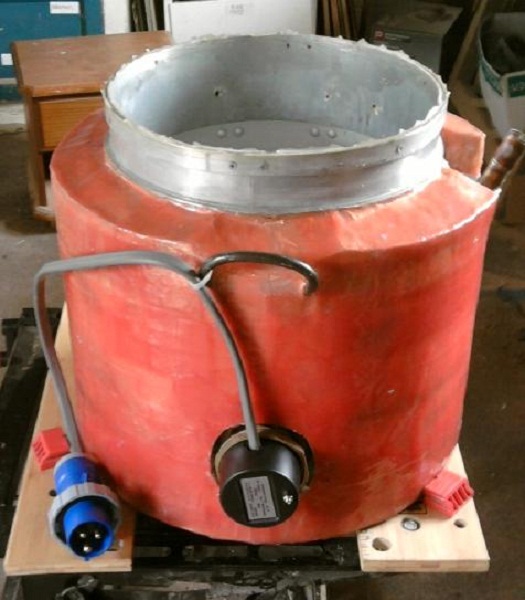
Next I completely encapsulated the pot in expanding foam. I simply made a cardboard pot 2" bigger than the boiler. I put some small wood blocks in the bottom so there is foam under the boiler as well as around the sides. Then just filled the gap with spray foam. After that for durability, I put a fibreglass skin on the outside of the insulation. Rock solid.
Now I use Propylene Glycol - this is food safe and is not your car antifreeze. It is a veterinary medicine and is also used to make soap, candles etc.
I admit it is not cheap but it has advantages that make it worth the expense IMO.
Pressurised Jacketed boilers (for steam) are not a home build option - unless building such things is your day job. I wouldn't consider building one myself.
However, a bain marie style pot in pot is an easy home build.
I cheated and managed to find a big aluminium double boiler.
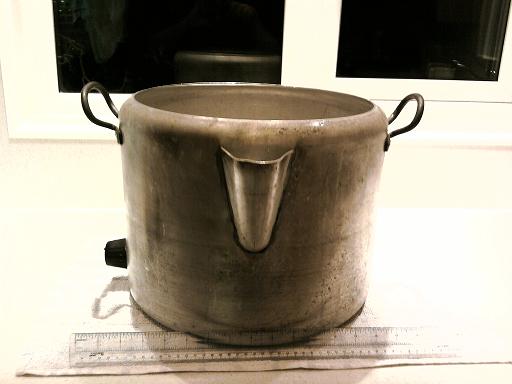
It used to belong to a scout group. I discarded the aluminium inner pot, but the use of aluminium for the outer is absolutely fine. First time round I fitted a kettle element. It lasted a few weeks.
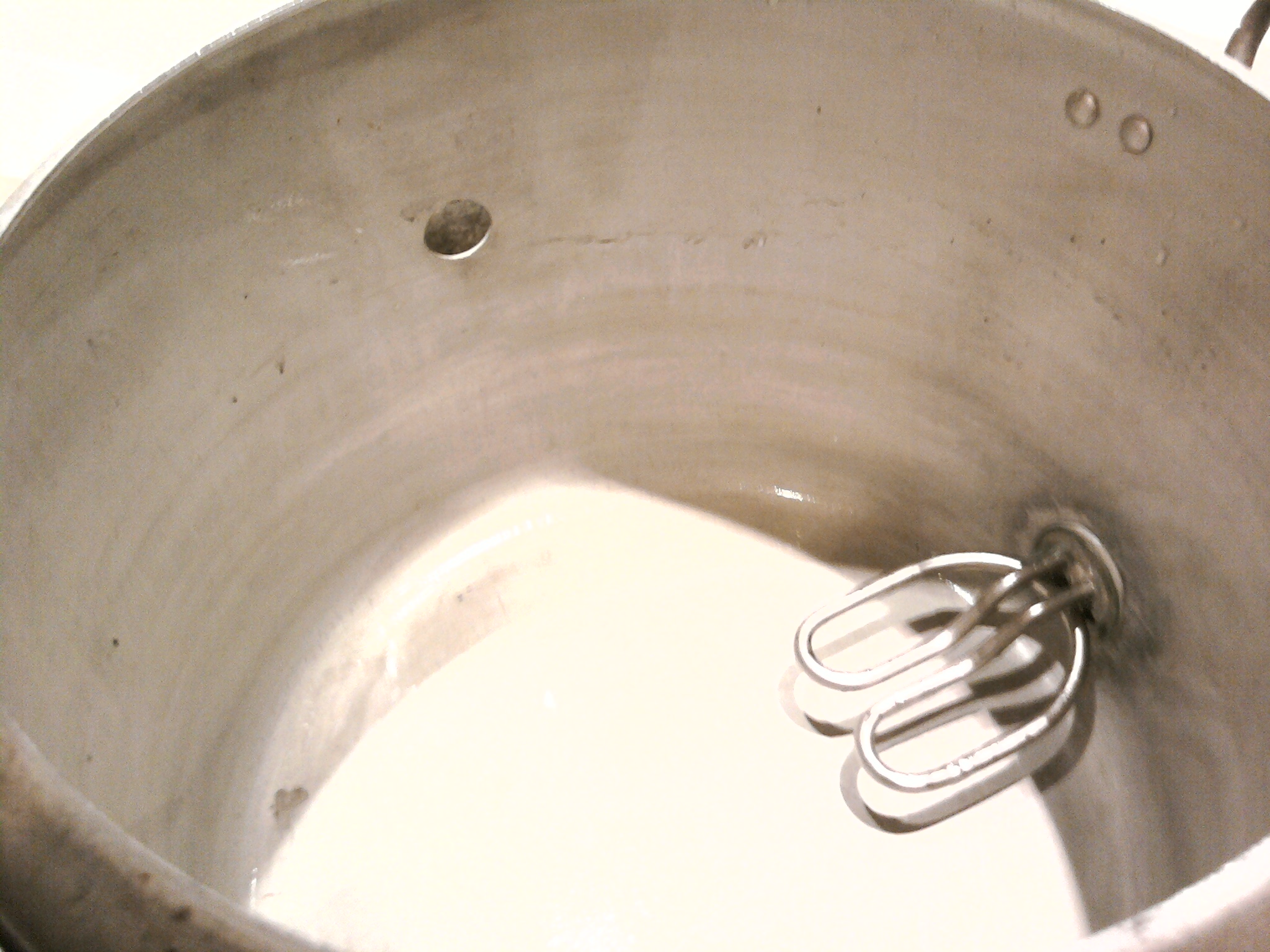
So I ditched that and used a standard 3 kW element instead. The compression style element bosses in our 2.25" size are easy enough to find.
Next I completely encapsulated the pot in expanding foam. I simply made a cardboard pot 2" bigger than the boiler. I put some small wood blocks in the bottom so there is foam under the boiler as well as around the sides. Then just filled the gap with spray foam. After that for durability, I put a fibreglass skin on the outside of the insulation. Rock solid.
-

Myles - Master Distiller

- Posts: 692
- Joined: Tue May 07, 2013 12:43 pm
Re: Glycol Double Boiler
by Myles » Fri Jun 21, 2013 8:41 pm
Because I used a stainless stock pot as the basis for my inner boiler, I had to add an aluminium extension collar to lift the stock pot above the element. Also the glycol needs room to expand. If you leave a ventilation space between the inner and outer pots you get glycol fumes in your still room. Some folks find these slightly irritant. My solution was to put in a vent tube but to have the end of the tube under the glycol surface. Only the fumes inside the vent tube itself can get out.
My inner boiler only lasted 6 months but I will show it anyway.
At first it seemed OK. I silver soldered a stainless bowl to the stock pot, cut the bottom out of the bowl and then soldered a copper planter to the bowl. It had a deep water filled seal like an alembic.
I used 56% silver solder and borax based flux. No problem it flowed perfectly and worked fine. Until 6 months later.
It was my poor technique at fault. I managed to overheat the stainless stock pot whilst soldering. Eventually a crack developed right along the edge of the join where the solder flowed onto the stainless steel. Probably due to different expansion coefficients between the solder and the stainless steel. After numerous heat and cool cycles the stainless steel failed.
This was a very cheap, very thin stock pot - really easy to get it too hot. Even a second or two creates a weak spot.
For soldering stainless to stainless now I would use a specialist soft solder from Cupalloy. Not for use between stainless and copper though, the flux is far to aggressive for the copper.
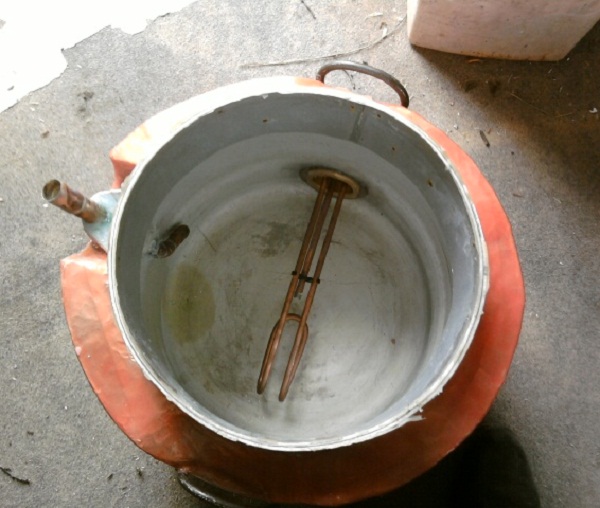
My inner boiler only lasted 6 months but I will show it anyway.
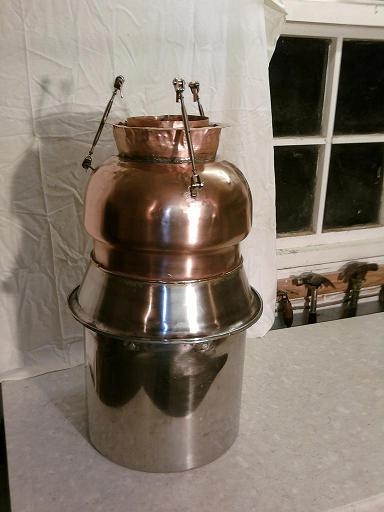
At first it seemed OK. I silver soldered a stainless bowl to the stock pot, cut the bottom out of the bowl and then soldered a copper planter to the bowl. It had a deep water filled seal like an alembic.
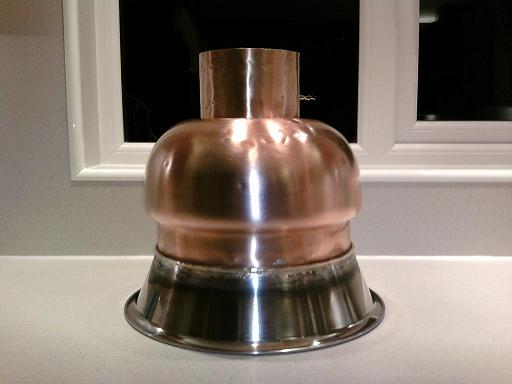
I used 56% silver solder and borax based flux. No problem it flowed perfectly and worked fine. Until 6 months later.
It was my poor technique at fault. I managed to overheat the stainless stock pot whilst soldering. Eventually a crack developed right along the edge of the join where the solder flowed onto the stainless steel. Probably due to different expansion coefficients between the solder and the stainless steel. After numerous heat and cool cycles the stainless steel failed.
This was a very cheap, very thin stock pot - really easy to get it too hot. Even a second or two creates a weak spot.
For soldering stainless to stainless now I would use a specialist soft solder from Cupalloy. Not for use between stainless and copper though, the flux is far to aggressive for the copper.
-
Myles - Master Distiller
- Posts: 692
- Joined: Tue May 07, 2013 12:43 pm
Re: Glycol Double Boiler
by Capt-Cudellez » Sat Jun 22, 2013 5:56 pm
I've always liked the look of that still when I saw it posted elsewhere.
What sort of recipes do you usually run in it. I can see it being of great benefit if running a thick mash like potatoes or corn, which I tend to have burning issues when I run.
What sort of recipes do you usually run in it. I can see it being of great benefit if running a thick mash like potatoes or corn, which I tend to have burning issues when I run.
-

Capt-Cudellez - Donated to StillSmart

- Posts: 1139
- Joined: Tue Dec 07, 2010 12:22 am
- Location: Scotland
- Stills: SS VM, Stripper, Pot
Re: Glycol Double Boiler
by googe » Sun Jun 23, 2013 3:54 am
Good work mate, I'm the same, always like the idea when I.seen it ages somewhere you posted it.
-

googe - Experienced Distiller

- Posts: 116
- Joined: Thu Feb 21, 2013 11:29 am
Re: Glycol Double Boiler
by Myles » Sun Jun 23, 2013 11:44 am
I made this because I mostly distil fruit. I don't bother with presses. I just ferment my fruit on the pulp, all mashed up with a sharpened mortar mixer.
When it has fermented I let it settle and rack off the clear wash into storage containers. The fruit pulp and yeast all gets loaded into the double boiler for a strip run.
That stripped low wines is then added to the cleared wash and run again for a spirit run. In reality this is a run and a half, more than a double run - but it works.
I usually strip 1/2 the wash volume.
When it has fermented I let it settle and rack off the clear wash into storage containers. The fruit pulp and yeast all gets loaded into the double boiler for a strip run.
That stripped low wines is then added to the cleared wash and run again for a spirit run. In reality this is a run and a half, more than a double run - but it works.
I usually strip 1/2 the wash volume.
-
Myles - Master Distiller
- Posts: 692
- Joined: Tue May 07, 2013 12:43 pm
5 posts
• Page 1 of 1
Who is online
Users browsing this forum: No registered users and 1 guest