Cheap and cheerful controller
 Posted: Tue Mar 04, 2014 9:42 am
All electrical wiring discussions begin with the advisory if you don't know what you are doing ask someone who does.
This set up assumes that you have a constant mains supply (so the results are repeatable) and one heater element ( otherwise more calculations required)
I have been using one of these ebay cheapies for over a year now. I use it to control an 1800 watt element on my T500 boiler. I have tried dual digital meters ( blew it up) and analogue meters ( have to convert the results) then I saw someone had calculated the wattage output of their controller at various settings and then created their own calibrations to match.
No more converting the volt amp readings to watts or trying to guess what the relative effect of Amps or Volts are on the heating process. I have been using this one for over a year. It runs cool for hours and despite my best attempts to blow it up it keeps going. If it was rubbish it would have given up the ghost a long time ago.
Kit:
one of these
http://www.ebay.co.uk/itm/AC-220v-3000W ... 3688wt_952
This one suits the T500 boiler (1800 watts) Bigger elements require bigger controllers.
A male plug
A female plug
(cut them off a lead or an appliance and save yourself the trouble of wiring it up and finding flex)
A tough plastic, clip lid lunch box
Tools:
Drill
Pliers
Screwdriver
multi meter
A circle of paper to be your dial (or mark it directly on to the lid)
An online calculator for watts ohms and volts
Drill holes in the lunch box. This stuff fractures so take it easy.
Mount the controller through the centre of the lid
Drill a hole either side for the male and female leads to go through
Pass the leads through the holes, strip the ends ready for wiring and then tie a single granny knot in the flex to prevent the lead passing back through the hole.
Wire up the controller as per the instructions (2 terminals closest to the top are the output)
Now calculate the "wattage" output of the controller at various settings
With the boiler unplugged, measure the resistance (Ohms) across the boiler element. It was easiest to do this across the top two terminals of the boiler plug. (Make sure the element is turned on if it has a switch). The resistance of the element in ohms is a constant value. Mine is about 32 ohms.
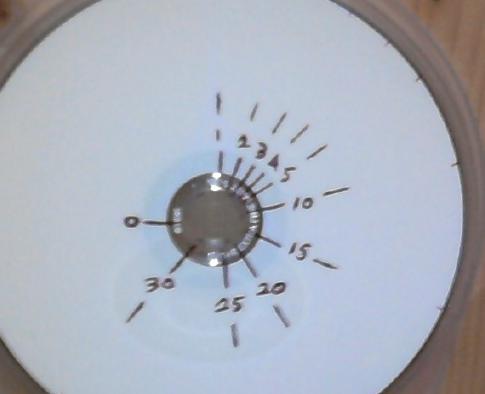
Next mark off the various wattages. Make sure your pot(entiometer) is firmly attached to the box or your markings will become rubbish. On your controller box around the pot knob, glue a piece of paper to mark off the various wattage settings or mark them onto the lid directly. Turn the controller to zero and mark that point. Turn it to full and mark that point.
Keep your meter probes clear of metal parts and your fingers clear of live terminals. With the controller powered up and the dial on full, use your multi meter to measure the voltage output of the controller (mine was 239 volts). Enter your voltage reading and the resistance of your element (a constant result) into the online calculator. Hit enter and you will now also have a wattage value for full power. Mark this on the dial at the full power mark (mine shows 1730 watts)
It is important to understand how the movement of the dial relates to power output. At the top end of the dial a small movement produces a big reduction in power while at the bottom end a lot of movement produces very little change. Reducing full power by 100 watts requires a tiny movement. Going from 100 watts down to zero takes nearly a quarter of a turn. What this means is you will have a lot of settings at one end of the dial and bugger all in the last half.
The scale I created reduces by about 200 watts a step. 300 watt steps would be fine. Subtract 300 watts from your full maximum watt value. Enter that figure along with your constant ohm figure into the online calculator. You will now have a new voltage figure. Use your multi meter and adjust your controller to produce that voltage value. Record that point and the wattage on your dial.
Subtract 300 watts from your last recorded wattage, enter that value along with the constant resistance figure into the calculator, get your new voltage required, use your multi meter, adjust the knob down till you get that voltage, mark the dial, move on to the next setting.
The main purpose of the dial for me is to give a better understanding of how much moving the controller knob reduces the power. Thinking that a quarter turn means quarter power will end in tears.
Cheers

This set up assumes that you have a constant mains supply (so the results are repeatable) and one heater element ( otherwise more calculations required)
I have been using one of these ebay cheapies for over a year now. I use it to control an 1800 watt element on my T500 boiler. I have tried dual digital meters ( blew it up) and analogue meters ( have to convert the results) then I saw someone had calculated the wattage output of their controller at various settings and then created their own calibrations to match.
No more converting the volt amp readings to watts or trying to guess what the relative effect of Amps or Volts are on the heating process. I have been using this one for over a year. It runs cool for hours and despite my best attempts to blow it up it keeps going. If it was rubbish it would have given up the ghost a long time ago.
Kit:
one of these
http://www.ebay.co.uk/itm/AC-220v-3000W ... 3688wt_952
This one suits the T500 boiler (1800 watts) Bigger elements require bigger controllers.
A male plug
A female plug
(cut them off a lead or an appliance and save yourself the trouble of wiring it up and finding flex)
A tough plastic, clip lid lunch box
Tools:
Drill
Pliers
Screwdriver
multi meter
A circle of paper to be your dial (or mark it directly on to the lid)
An online calculator for watts ohms and volts
Drill holes in the lunch box. This stuff fractures so take it easy.
Mount the controller through the centre of the lid
Drill a hole either side for the male and female leads to go through
Pass the leads through the holes, strip the ends ready for wiring and then tie a single granny knot in the flex to prevent the lead passing back through the hole.
Wire up the controller as per the instructions (2 terminals closest to the top are the output)
Now calculate the "wattage" output of the controller at various settings
With the boiler unplugged, measure the resistance (Ohms) across the boiler element. It was easiest to do this across the top two terminals of the boiler plug. (Make sure the element is turned on if it has a switch). The resistance of the element in ohms is a constant value. Mine is about 32 ohms.
Next mark off the various wattages. Make sure your pot(entiometer) is firmly attached to the box or your markings will become rubbish. On your controller box around the pot knob, glue a piece of paper to mark off the various wattage settings or mark them onto the lid directly. Turn the controller to zero and mark that point. Turn it to full and mark that point.
Keep your meter probes clear of metal parts and your fingers clear of live terminals. With the controller powered up and the dial on full, use your multi meter to measure the voltage output of the controller (mine was 239 volts). Enter your voltage reading and the resistance of your element (a constant result) into the online calculator. Hit enter and you will now also have a wattage value for full power. Mark this on the dial at the full power mark (mine shows 1730 watts)
It is important to understand how the movement of the dial relates to power output. At the top end of the dial a small movement produces a big reduction in power while at the bottom end a lot of movement produces very little change. Reducing full power by 100 watts requires a tiny movement. Going from 100 watts down to zero takes nearly a quarter of a turn. What this means is you will have a lot of settings at one end of the dial and bugger all in the last half.
The scale I created reduces by about 200 watts a step. 300 watt steps would be fine. Subtract 300 watts from your full maximum watt value. Enter that figure along with your constant ohm figure into the online calculator. You will now have a new voltage figure. Use your multi meter and adjust your controller to produce that voltage value. Record that point and the wattage on your dial.
Subtract 300 watts from your last recorded wattage, enter that value along with the constant resistance figure into the calculator, get your new voltage required, use your multi meter, adjust the knob down till you get that voltage, mark the dial, move on to the next setting.
The main purpose of the dial for me is to give a better understanding of how much moving the controller knob reduces the power. Thinking that a quarter turn means quarter power will end in tears.
Cheers