Yet another power comtroller
Re: Yet another power comtroller
 by ant » Wed Jun 10, 2015 11:11 am
Ok. I have it now. Instead of connecting the fixed resistor between the two ends of the track you connect it between the CCW terminal and the wiper. You then take your feed from the same two terminals. As you swipe you have a varying resistance in parallel with a fixed resistance and this gives you your curve. They call these fixed resistors tapering resistors. Vary the value of the resistor and you vary the curve. It still jumps to zero at the end as you short the fixed resistor out. Do it right and you have a reverse log pot from a linear pot by adding a tapering resistor.
You can vary the curve by changing the value of the fixed resistor.
The main idea of adding a fixed resistor across the two track terminals is to reduce the max value of the pot. It still produces it's own skew but in this case you are stuck with the one value that gives you the right max value you want to reduce a larger pot down to.
Putting the two together is beyond my tired head's current ability to visualise.
Be easier to play and see I think.
You can vary the curve by changing the value of the fixed resistor.
The main idea of adding a fixed resistor across the two track terminals is to reduce the max value of the pot. It still produces it's own skew but in this case you are stuck with the one value that gives you the right max value you want to reduce a larger pot down to.
Putting the two together is beyond my tired head's current ability to visualise.
Be easier to play and see I think.
-

ant - Senior Distiller

- Posts: 266
- Joined: Tue Apr 17, 2012 2:50 pm
Re: Yet another power comtroller
by ant » Thu Jun 11, 2015 7:59 pm
The replacement meter is looking good. I did a simple test turning a kettle down to around five amps and the watts were about half what VxA would indicate. This is good. It is measuring true RMS most likely by using a very high sample frequency.
I am amazed these cheap Chinese watt meters do the same job as much more expensive metering.
I am amazed these cheap Chinese watt meters do the same job as much more expensive metering.
-
ant - Senior Distiller
- Posts: 266
- Joined: Tue Apr 17, 2012 2:50 pm
Re: Yet another power comtroller
by Easydrinker » Thu Jun 11, 2015 11:23 pm
To a simpleton like myself,this post is quite gob-smacking.
From trying to follow you on this thread,it seems to be as you expected or hoped for.
Maybe one day you could post an idiots guide.
Sometimes I think I understand your comments,others my eyes just glaze over.
Best of luck with it.
Robert.
From trying to follow you on this thread,it seems to be as you expected or hoped for.
Maybe one day you could post an idiots guide.
Sometimes I think I understand your comments,others my eyes just glaze over.
Best of luck with it.
Robert.
There is no ONE way.
-

Easydrinker - Donated to StillSmart

- Posts: 5208
- Joined: Fri Jun 21, 2013 7:09 pm
- Location: The hills of lowland Scotland
- Stills: Smart & Silly
Re: Yet another power comtroller
by ant » Sat Jun 13, 2015 3:24 pm
Sorry Robert. It was a quick post and I was excited.
It is what I hoped not what I expected.
It turns out this meter dies from being connected to the chopped output voltage so it is connected to the input voltage. The volts always reads 240v. So far not ideal.
If this were a lesser meter it would take the current times it by 240 and come up with an apparent wattage. This would be correct before you start to turn the power down. As you turn the power down the real output volts would be more and more different and the wattage assumed by always using 240 would be more and more off. At low power it would be way off. Not good.
This meter does not do that. Whew!
To explain what it does you have to remember that 240v is just an average of a constantly changing voltage whose changes follow a sine wave.
What this meter does to calculate power is sample the instantaneous voltage many times during each cycle of the sine wave. It compares this to current to produce the power reading. As there is no current when the controller has the output turned off the power value for those moments is zero. Any volts times zero is still zero. When current is flowing it is multipled by the actual voltage at that tiny moment in the rise and fall of the sine wave. Not the 240v average. So we get a true measure of power when all these very fast tiny readings are summed together fifty times a second to produce the actual power used from each cycle of the sine wave.
It doesn't matter that we are on the input. The input and output are always at the same point in the sine wave at the same time.
The volts are always at 240 becuase they are not being compared to current and haveing some of the readings cancelled out when current is zero.
There is some math regarding power factor and square roots that predicts what the power should be for a given setting. This confirms that the power the meter is showing is the right one.
I'll save that for another post as I have work to do.
It is what I hoped not what I expected.
It turns out this meter dies from being connected to the chopped output voltage so it is connected to the input voltage. The volts always reads 240v. So far not ideal.
If this were a lesser meter it would take the current times it by 240 and come up with an apparent wattage. This would be correct before you start to turn the power down. As you turn the power down the real output volts would be more and more different and the wattage assumed by always using 240 would be more and more off. At low power it would be way off. Not good.
This meter does not do that. Whew!
To explain what it does you have to remember that 240v is just an average of a constantly changing voltage whose changes follow a sine wave.
What this meter does to calculate power is sample the instantaneous voltage many times during each cycle of the sine wave. It compares this to current to produce the power reading. As there is no current when the controller has the output turned off the power value for those moments is zero. Any volts times zero is still zero. When current is flowing it is multipled by the actual voltage at that tiny moment in the rise and fall of the sine wave. Not the 240v average. So we get a true measure of power when all these very fast tiny readings are summed together fifty times a second to produce the actual power used from each cycle of the sine wave.
It doesn't matter that we are on the input. The input and output are always at the same point in the sine wave at the same time.
The volts are always at 240 becuase they are not being compared to current and haveing some of the readings cancelled out when current is zero.
There is some math regarding power factor and square roots that predicts what the power should be for a given setting. This confirms that the power the meter is showing is the right one.
I'll save that for another post as I have work to do.
-
ant - Senior Distiller
- Posts: 266
- Joined: Tue Apr 17, 2012 2:50 pm
Re: Yet another power comtroller
by ant » Sat Jun 13, 2015 11:47 pm
This is the math a clever chap called Edwin worked out after making a series of measurements with a known calibrated true RMS test meter.
There seems to be a square root relation between power setting and power factor:
At 1.00 power the power factor is √ 1 = 1 and VA is power / 1.000 or power * 1
At 0.75 power the power factor is √ 0,75 = 0.866 and VA is power / 0.866 or power * 1.156
At 0.50 power the power factor is √ 0,50 = 0.707 and VA is power / 0.707 or power * 1.414
At 0.25 power the power factor is √ 0,25 = 0.500 and VA is power / 0.500 or power * 2
This peacefair meter seems to fit what this predicts so, yaaay!
There seems to be a square root relation between power setting and power factor:
At 1.00 power the power factor is √ 1 = 1 and VA is power / 1.000 or power * 1
At 0.75 power the power factor is √ 0,75 = 0.866 and VA is power / 0.866 or power * 1.156
At 0.50 power the power factor is √ 0,50 = 0.707 and VA is power / 0.707 or power * 1.414
At 0.25 power the power factor is √ 0,25 = 0.500 and VA is power / 0.500 or power * 2
This peacefair meter seems to fit what this predicts so, yaaay!
-
ant - Senior Distiller
- Posts: 266
- Joined: Tue Apr 17, 2012 2:50 pm
Re: Yet another power comtroller
by Easydrinker » Sun Jun 14, 2015 9:21 am
Thanks for taking the time to explain.
I actually understand what you were saying and doing.
And it seems you are now the owner of a very accurate meter.
Robert.
I actually understand what you were saying and doing.
And it seems you are now the owner of a very accurate meter.
Robert.
There is no ONE way.
-
Easydrinker - Donated to StillSmart
- Posts: 5208
- Joined: Fri Jun 21, 2013 7:09 pm
- Location: The hills of lowland Scotland
- Stills: Smart & Silly
Re: Yet another power comtroller
by ant » Sun Jun 14, 2015 8:40 pm
I'm glad I was clear. I used to teach and I like how things work.
Unrequited paternalism I expect.
I'm sure it was your example I was originally following. Your plug in jobby may well be the same. Turn the controller down low and note the amps and watts. If multiplying the amps by 240 is very different from the watts you are winning.
Technically what I have is a device with a true RMS meter in it. Rather than a true true RMS metet. I can't use it as is to directly measure an irregular wave form as the power supply design will kill it. But it works as is for our app.
It's a bit of a subtle difference but there. If the measuring inputs were seperated from the power supply inputs it would be a true true RMS meter. You could connect the PSU to 240v and the measuring input to your clipped waveform and measure any output directly. It might be possible to modify if pushed. I'd pay the extra quid if they just made it that way to begin with. All to save on the cost of two extra terminals. Bean counters.
Unrequited paternalism I expect.
I'm sure it was your example I was originally following. Your plug in jobby may well be the same. Turn the controller down low and note the amps and watts. If multiplying the amps by 240 is very different from the watts you are winning.
Technically what I have is a device with a true RMS meter in it. Rather than a true true RMS metet. I can't use it as is to directly measure an irregular wave form as the power supply design will kill it. But it works as is for our app.
It's a bit of a subtle difference but there. If the measuring inputs were seperated from the power supply inputs it would be a true true RMS meter. You could connect the PSU to 240v and the measuring input to your clipped waveform and measure any output directly. It might be possible to modify if pushed. I'd pay the extra quid if they just made it that way to begin with. All to save on the cost of two extra terminals. Bean counters.
-
ant - Senior Distiller
- Posts: 266
- Joined: Tue Apr 17, 2012 2:50 pm
Re: Yet another power comtroller
by Myles » Mon Jun 15, 2015 4:46 am
I may be a bit late to contribute to this but I have built a couple of controllers for up to 6kW.
Firstly the output voltage needs to be measured between the two element legs and the current in series with one of the element legs. Probably obvious but the first time I did it I got it wrong and tried to measure the voltage between element and earth - oops!!
Regarding lag. In my own controller there are actually two controllers. One is a PWM 40 Amp component built kit, it is one of pintoshines from Artisan Distiller. This one shows the threshold voltage. You need to turn the control up to get the device to switch on, but you can then back it off again and it remains on below the threshold voltage. I calibrated this on a 3kW element.
The other is an off the shelf Burst Modulated controller from United Automation. There is no observable threshold. You turn it up and it switches on, back it off and it switches off at the same point.
The other I built was a United Automation PSR 40 PWM again, it is just the same. No observable threshold, just on and off at the same point. I suspect these encapsulated controllers have additional circuits to eliminate the threshold seen on my component built kit.
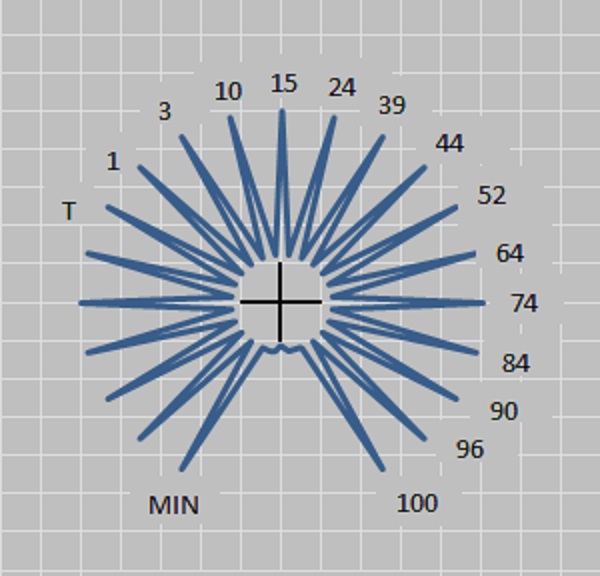
Just for info this is the calibrated dial of the PSR40 on a 6kW load. Percentage of power to indicate the linearity of the device.
Firstly the output voltage needs to be measured between the two element legs and the current in series with one of the element legs. Probably obvious but the first time I did it I got it wrong and tried to measure the voltage between element and earth - oops!!
Regarding lag. In my own controller there are actually two controllers. One is a PWM 40 Amp component built kit, it is one of pintoshines from Artisan Distiller. This one shows the threshold voltage. You need to turn the control up to get the device to switch on, but you can then back it off again and it remains on below the threshold voltage. I calibrated this on a 3kW element.
The other is an off the shelf Burst Modulated controller from United Automation. There is no observable threshold. You turn it up and it switches on, back it off and it switches off at the same point.
The other I built was a United Automation PSR 40 PWM again, it is just the same. No observable threshold, just on and off at the same point. I suspect these encapsulated controllers have additional circuits to eliminate the threshold seen on my component built kit.
Just for info this is the calibrated dial of the PSR40 on a 6kW load. Percentage of power to indicate the linearity of the device.
-

Myles - Master Distiller

- Posts: 692
- Joined: Tue May 07, 2013 12:43 pm
Re: Yet another power comtroller
by ant » Mon Jun 15, 2015 12:29 pm
On this particular design the volts is taken from between neutral and the live input to the controller. The amps are sensed inductively by a small current transformer slipped over the output live from the controller. The hows and whys are above somewhere.
I have heard that some triac circuits suffer from switching hysteresis causing lag. As you say these controllers seem better designed. They are triac based on the inside and prolly controlled by a resistance capacitance timing circuit. This control circuit is one reason why they are non linear.
Thank you for the dial. I see that exactly a third of the dial has no effect. I suggest replacing the pot with one two thirds of the value. This will eliminate the dead zone at the beginning and increase resolution as the remaining two thirds are spread across the full adjustment of the new pot.
I have heard that some triac circuits suffer from switching hysteresis causing lag. As you say these controllers seem better designed. They are triac based on the inside and prolly controlled by a resistance capacitance timing circuit. This control circuit is one reason why they are non linear.
Thank you for the dial. I see that exactly a third of the dial has no effect. I suggest replacing the pot with one two thirds of the value. This will eliminate the dead zone at the beginning and increase resolution as the remaining two thirds are spread across the full adjustment of the new pot.
-
ant - Senior Distiller
- Posts: 266
- Joined: Tue Apr 17, 2012 2:50 pm
Re: Yet another power comtroller
by Myles » Mon Jun 15, 2015 6:28 pm
You will always get a dead zone. You need a certain current to trigger fhe triac. How much depends on the component in use but there is always a trigger current to open the gate.
It's inherent in the design of the circuit. Typicaly there is a diac controlling a triac.
Both components have their own trigger voltage and these combine to create fhe dead zone. In reality it does not matter. You have ample power control in the remainder of the range.
I suppose an advantage of the component built circuit is the ability to back off the current. On my pintocontroller, once it is switched on and conducting, I can back it off to about 700 watts. Try that on a PSR 20 or 40!!
It's inherent in the design of the circuit. Typicaly there is a diac controlling a triac.
Both components have their own trigger voltage and these combine to create fhe dead zone. In reality it does not matter. You have ample power control in the remainder of the range.
I suppose an advantage of the component built circuit is the ability to back off the current. On my pintocontroller, once it is switched on and conducting, I can back it off to about 700 watts. Try that on a PSR 20 or 40!!
-
Myles - Master Distiller
- Posts: 692
- Joined: Tue May 07, 2013 12:43 pm
Re: Yet another power comtroller
by ant » Mon Jun 15, 2015 7:09 pm
No I don't think so, not always. If you change the value of the pot it will be starting at the point it turns on with your current pot.
As you turn the power up you are turning the resistance down. Using a smaller value pot you can start at the resistance that triggers the circuit instead of waiting to get it down that low. There is no difference between your current pot turned down to the trigger point and a new pot that starts at that same value. The controller still does need that min power to turn on but you start right there and don't waste pot track getting to it.
You just lose the dead zone and increase resolution. All good but if you are happy with what you have stick with it.
As you turn the power up you are turning the resistance down. Using a smaller value pot you can start at the resistance that triggers the circuit instead of waiting to get it down that low. There is no difference between your current pot turned down to the trigger point and a new pot that starts at that same value. The controller still does need that min power to turn on but you start right there and don't waste pot track getting to it.
You just lose the dead zone and increase resolution. All good but if you are happy with what you have stick with it.
Last edited by ant on Mon Jun 15, 2015 10:31 pm, edited 1 time in total.
-
ant - Senior Distiller
- Posts: 266
- Joined: Tue Apr 17, 2012 2:50 pm
Re: Yet another power comtroller
by ant » Mon Jun 15, 2015 7:41 pm
I think I am misunderstanding something on a different point.
After the trigger point your dial indicates 1% power. From 6kw this would seem to be 60w.
Yet you state you cannot turn it down to 700w. I find that confusing. Is the percentage range spread over the available wattage that starts somewhere above 700w?
After the trigger point your dial indicates 1% power. From 6kw this would seem to be 60w.
Yet you state you cannot turn it down to 700w. I find that confusing. Is the percentage range spread over the available wattage that starts somewhere above 700w?
-
ant - Senior Distiller
- Posts: 266
- Joined: Tue Apr 17, 2012 2:50 pm
Re: Yet another power comtroller
by Myles » Tue Jun 16, 2015 7:27 am
My controllers are calibrated for both voltage and current on the output from the controller. The encapsulated version (PSR40) used for the dial shown did actually have a usable range of 1% up to 100% power.
This was unusual in my view as some of the other encapsulated versions I have seen do not do this.
On my component built circuit (with a 3kW element) at switch on it is already conducting at over 1kW but once conducting I can reduce it to about 300 watts at which point it switches off.
Most of these circuits use the pot to control a Diac and the current flowing through the Diac in turn switches on a Triac. What is actually important is the minimum current flow in the triggering circuit.
When the Triac switches on the output current jumps from zero to about 1/3 of full current. On most once triggered you can reduce that current but usually not all the way to zero. I suppose it all depends on the type of triggering circuit used.
This was unusual in my view as some of the other encapsulated versions I have seen do not do this.
On my component built circuit (with a 3kW element) at switch on it is already conducting at over 1kW but once conducting I can reduce it to about 300 watts at which point it switches off.
Most of these circuits use the pot to control a Diac and the current flowing through the Diac in turn switches on a Triac. What is actually important is the minimum current flow in the triggering circuit.
When the Triac switches on the output current jumps from zero to about 1/3 of full current. On most once triggered you can reduce that current but usually not all the way to zero. I suppose it all depends on the type of triggering circuit used.
-
Myles - Master Distiller
- Posts: 692
- Joined: Tue May 07, 2013 12:43 pm
Re: Yet another power comtroller
by ant » Tue Jun 16, 2015 9:28 am
That is interesting. Sounds as though you got lucky with that one.
It will of course depend partly on the size of load you put on. 1% of 6kw is bigger than 1% of 3kw.
The dodge of using a smaller pot to optimise control assumes you know the largest load you will use and size to that. If you then switch to a smaller load there will still be a bit of dead wasted track on the pot. Just not so much.
If you go the other way and switch to a larger load than the one you used to size the pot you will be straight in at a higher power than you could have turned down if there was pot track there to do so. Which might be bad. Certainly less than ideal to the purist mind even if it is still low enough in practice.
I'll let you know how mine works after I play with some tapering resistors.
It will of course depend partly on the size of load you put on. 1% of 6kw is bigger than 1% of 3kw.
The dodge of using a smaller pot to optimise control assumes you know the largest load you will use and size to that. If you then switch to a smaller load there will still be a bit of dead wasted track on the pot. Just not so much.
If you go the other way and switch to a larger load than the one you used to size the pot you will be straight in at a higher power than you could have turned down if there was pot track there to do so. Which might be bad. Certainly less than ideal to the purist mind even if it is still low enough in practice.
I'll let you know how mine works after I play with some tapering resistors.
-
ant - Senior Distiller
- Posts: 266
- Joined: Tue Apr 17, 2012 2:50 pm
Re: Yet another power comtroller
by ant » Tue Jun 16, 2015 6:57 pm
Been busy working so not had time for a proper play but a quick update on my impressions of the meter.
When it is turned right down using the unmodded 500K pot it seems to take a noticable time to update the display. This is a bit irritating but I suppose I can live with it.
Sometimes the reading changes to zero then back to a value next time. This might just be the controller right on the edge of it's trigger current responding as the mains input power fluctuates slightly. Best guess so far.
This all happens at about seven percent of what I assume is a 2kw kettle element. 140ish watts. I'm assuming it will always need that min wattage but the percentage will look better on a larger element.
I think I can probably live with a 150w min power to round it up a bit.
Any opinions to contradict that please speak up.
When it is turned right down using the unmodded 500K pot it seems to take a noticable time to update the display. This is a bit irritating but I suppose I can live with it.
Sometimes the reading changes to zero then back to a value next time. This might just be the controller right on the edge of it's trigger current responding as the mains input power fluctuates slightly. Best guess so far.
This all happens at about seven percent of what I assume is a 2kw kettle element. 140ish watts. I'm assuming it will always need that min wattage but the percentage will look better on a larger element.
I think I can probably live with a 150w min power to round it up a bit.
Any opinions to contradict that please speak up.
-
ant - Senior Distiller
- Posts: 266
- Joined: Tue Apr 17, 2012 2:50 pm
Who is online
Users browsing this forum: Baidu [Spider] and 0 guests